CLICK HERE FOR THOUSANDS OF FREE BLOGGER TEMPLATES »
Showing posts with label Ball Control. Show all posts

Wednesday, July 16, 2008

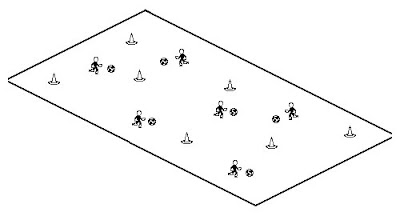
4v4 With Gatekeepers

This coach uses players as his gatekeepers, when I do this drill I use parents. That allows more players to actually be involved in the play - as parents like to be involved. This is normally an Under 8 drill, but I've used late in the season for Under 6 and early in the season for Under 10.

This is a great game to get the players to keep their heads up and looking around for the opening.


Monday, July 14, 2008

Dribbling With The Laces (Top of the Foot)

Dribbling at high speed requires the use of the "laces" or the top of the foot. A natural running style exposes the top of the foot to the ball as the player is running, therefore this should be a natural dribbling style when at speed.

We want players that can dribble at high speed because that can attack the defenders and get them off balanced quickly. Below is a video with Mia Hamm explaining the technique.


The Receive and Turn Drill

This drill will work well with Under 8 and up players. Younger players should focus on ground balls, older players can mix it up with both ground and lofted balls.Organization -

  • Balls start on the outside.
  • Players on the inside move to receive a ball from a player on the outside, then give the ball back to a different player on the outside.
Technique -
  • Proper receiving with the inside and outside of the foot. Use of the thigh or chest for lofted balls.
  • Work on various turning techniques like shielding.
Coaching Points -
  • Move with the head up
  • Communication and awareness (visual and verbal)
  • Change speed
  • Find options early
  • Timing of the run, so you are moving when you receive the ball
  • Change of speed with and without the ball
  • Keeping eye on the ball
  • Relax the controlling surface
Variations -
  • Players on the outside serve with their hands (like a goalkeeper)

Wednesday, July 9, 2008

Using The Outside Part of the Foot

The outside part of the foot is probably the most overlooked part of the foot. Many youth players focus on the inside part and don't realize that by using the outside part of the foot they will create more opportunities to beat a defender. Mia Hamm demonstrates in the video below.


Wednesday, July 2, 2008

Inside Part of the Foot Drill

Using the Inside Part of the Foot is a critical skill that players must develop to be successful. Below Mia Hamm demonstrates the key points of using the inside part of the foot and shows and excellent drill that coaches can use up a warm up in their practices to get players thinking about this aspect of their game.


Tuesday, July 1, 2008

Why the First Touch Matters


From Anson Dorrance's Soccer Clinic video, you can see why the first touch a player makes sets up everything after that.

The Dribbling Attack Activity

This activity works with all age groups.

Play 3v3 in a 30 x 20 yard grid. Put the two groups of three into different colored training bibs. Each player in one group has a ball. Attacking players must dribble past defending players. The defending players should try to gain possession and (if they do) then dribble past an opponent. Players may dribble in any direction inside the grid to start. The activity can progress when the coach gives the attack a direction (e.g., dribble to a specified goal line). Play a round for a set amount of time. After a round the groups switch roles.

Suggestions of time to play -
U6: play one minute rounds
U8: play two minute rounds
U10: play three minute rounds
U12: play four minute rounds
U14: play five minute rounds

Friday, June 27, 2008

Receiving Skill - Cushioning The Ball

When a hard ball is coming at a player and this player is trying to receive the ball, the key is to cushion the ball as it arrives. While this might seem quite obvious, the reality is many young players tense up as the ball approaches, which results in the ball hitting their foot (or other party part) and bouncing away. The more relaxed your body is when the ball arrives, the easier it will be to control the ball.

As an example, think of trying to catch an egg. When the egg makes contact with your hands, if you don't give, the egg will break in your hands. If, upon contact with the egg, you pull back to soften the contact, you will catch the egg and it will stay intact.

Receiving the ball uses the same concept, As the ball makes contact with your foot, relax and pull your foot back to soften the blow. This will allow you to maintain control of the ball, regardless of how hard it was hit.

It's the same concept with using other parts of the body to receive the ball. If the ball is coming in chest high, when the ball makes contact with your chest, bend your knees some and lean back. This movement will cushion the ball upon contact and allow for easy control of the ball.

If the ball comes in thigh high, when the ball makes contact with your thigh, pull your thigh back a bit to provide the cushion and the ball will drop down to your feet.

Just remember, relax and cushion the ball as it arrives and you will find you have much greater control of the ball.

Wednesday, June 25, 2008

Under 8 Drill - "Ball Retrieve in Pairs"

Organization:
Each pair has a ball which in turn they give to the coach. The coach tosses the ball away and each pair must retrieve the ball as quickly as possible and bring it back to the coach. The players must bring the ball back a different way each time, e.g. balanced between two backs, balanced between two heads, throwing the ball to each other, passing the ball to each other. The coach can also limit the number of touches a pair may have when returning the ball.

Variation:
The coach may move and change position which encourages players to look up.

Friday, June 20, 2008

Under 6 Drill - "Bingo!"

Organization:
A number of cones are distributed throughout the training area. One player and the coach are the “replacers.” Each player has a ball. The players with the balls try to knock down as many cones as possible with their balls. The “replacers” (all players take turns in this role) set up the cones as fast as they are knocked down. When a player knocks down a cone they yell bingo. The player who scores the most bingos wins the game.

Wednesday, June 18, 2008

The Outside of the Foot Pass/Shoot - Ricardo Quaresma

The "Trivela" kick is a sneaky kick because it comes off of the outside part of the foot. Ricardo Quaresma, currently a player on FC Porto in Portugal, is a master of it and thus a very dangerous player. Quaresma ability to use the outside part of the foot can deceive a defender, because he can make a pass to the side in the blink of an eye. Using the outside part of the foot during a shoot can put a wicked spin on the ball confusing a goalkeeper, who may think at first the ball is going one way, but then bends back and goes into the goal.


Monday, June 16, 2008

Using The Proper Soccer Ball For The Proper Age

Prior to the start of a training session, I had an Under-10 player approach me and tell me that he went home to work on his shooting (our prior practice was focused on proper shooting technique) and something wasn't right. During our previous practice, he was really getting speed and accuracy on his shots, but at home he said he was struggling to get the ball up and his shots were all over the place. I told him to go get a ball and let's look at it.

He ran over to his bag and pulled out his soccer ball, and right then I saw what was wrong. He had a size 5 soccer ball, the wrong size ball for his age. There is a reason soccer balls are numbered, so they are the appropriate size for the age that uses them. Under 6 and Under 8 need to be using size 3 soccer balls, Under 10 and Under 12 need to be using size 4. Not until a player enters the Under 14 ranks, should they be using a size 5 (normal soccer ball).

I quickly grabbed a size 4 soccer ball for the player and let him practice a couple shots again and to no surprise his distance and accuracy returned.

As an adult, when I play with a size 3 or size 4 soccer, I am Superman because the ball is smaller and lighter. So what do you think happens to a child using an adult ball? The complete opposite and that will destroy their development. We want them to grow with the ball, not be hampered by it.

So make sure you have the right ball for the right age.

Thursday, June 12, 2008

They're All Bunch Up!!

From Ihor Chyzowych, Ohio South Youth Soccer Association -


That's what I hear at every U-8 youth course I teach. My reply is always the same: "That's OK!"

Then I get the puzzled looks from nearly every coach or coach-to-be.

The kids know what they're doing, it's the parents and the new coaches who are confused.

Adults see the bunch of players as unorganized -- not as a team. That's the first problem. Because, at this point, it's really not a team.

The players at this age don't understand what being a "team" means. At their age, they are selfish in their game. Me, my ball, my game. Most kids can't even remember the name of their team or their coach. They won't even practice with any one else's ball! How can you expect them to understand or embrace teamwork or fixed positions?

The ball is their magnet; so let them try to get it. In doing so, they're actually building good instincts that they'll use in the game when they are older and "team" actually beginsto mean something.

For example, many good coaches struggle to "re-teach" 14 to 17 year olds the working concept of zonal defending and zonal pressure defense. Two concepts that they knew instinctively when they were 5. What happened? It was drilled out of them by a youth coach who kept telling them to spread out.

When they're 5-plus years old, they already have a natural instinct for this kind of defending. They're already figured out that five of us versus one of them means that we'll probably get the ball.

To parents, this is a mess on the field. They want the kids to spread out -- so that the one player with any skill can have the space to dribble around every one else like cones. Not a very good defense.

A good coach will definitely have to adjust these players' instincts, as they get older, but surprisingly not much. The game itself makes them smarter as they continue to play more and more.

Another reason why "bunching up" is OK for young players: the kid in the center of that bunch is learning early on how to play in tight spaces and not to be afraid of traffic or contact -- invaluable skills that will be second-nature to him by the time he's older and able to play in fixed positions.

So, as hard as it is for parents to believe, young players learn how to solve problems and be creative while bunched up. These skills actually help them with their game when they're older and that game is more structured.

As a coach, I'll want on my older team the youth player who consistently came out of the pack with the ball. He might be my striker because he's not afraid of crowds in the box, or of being marked by two players. He's been getting through the traffic and scoring in those situations since he was 5. Playing in "the bunch" has made him tough, technical and smart.

My advice to new youth coaches and to parents is to stop worrying about the kids being bunched up. At U-8, just let them play.

You're role at this point is to teach them some basic ball touches, point them in the right direction and let them go!

Let the game teach them for now. Let them teach themselves. And most of all let them enjoy the game. Seems simple? It is. But that's OK, too. That's the beauty of soccer.

Under 8 Drill - "Crush The Snow Cone"


This is a passing drill with emphasis on hitting a target under pressure.

Organization:
  1. Teams are split into two teams. For this example, a red and a yellow team.
  2. The yellow team has to keep possession of the two soccer balls that are in the field of play and hit the balls off the cones.
  3. The red team has to defend and not allow them to strike the ball off of the cones.

Coaching Points:

  1. Keep your head up to see where the snow cones are not defended.
  2. Use either the laces or the side of the foot to knock ball off of the cone.
  3. If the cone is defended dribble off to find the open cone.

Wednesday, June 11, 2008

Backyard Activities - "Nutmeg"

Backyard Activities are drills that a player can do at home with a sibling, a friend, Mom, or Dad.


Activity - "NUTMEG"

Set up small goals with cones about 1 step apart. Place many of these goals around your yard at different angles. Dribble your ball toward a goal and push your ball through the goal. While the ball travels through the goal, you must run around the goal and retrieve the ball on the other side (nutmeg). As soon as you regain control of the ball, dribble at one of the other goals and nutmeg again. Nutmeg as many goals as you can in 30 seconds (ask your friend, mom or dad to time you). The next time you do it, try to increase the number of goals that you nutmeg in 30 seconds by at least one.

Backyard Activities - "Kicking (Wall) Tennis and Squash"

Backyard Activities are drills that a player can do at home with a sibling, a friend, Mom, or Dad.

Activity - "KICKING (WALL) TENNIS AND SQUASH"

If you have access to a wall that you can kick your soccer ball against and your parents permission, consider the following soccer activities:


Tennis: Volley your ball against the wall with one or two bounces in between each volley. Eventually, keep the ball going with only one bounce in between volleys. Vary your distance from the wall as you play. See how many times you can keep the ball going as you move closer to and farther from the wall. Use different surfaces of your foot and develop a rhythm.


Set up a rectangular court out from the wall and play soccer tennis against the wall with a friend. Set up your own rules with regards to services and bounces, etc.


Squash: This game is played with more than one player. You can set up a rectangular court or play in an open area.


After a kicking order has been determined, the player #1 kicks the ball off the wall. The player #2 must get to the ball before it stops and immediately kick (1-touch) the ball against the wall. If there are more than 2 players, the game proceeds accordingly until all the players have kicked the ball against the wall, at which time the first player is up again. You get a point if the player that follows you allows the ball to stop before she kicks it or if she misses the wall on her kick. Play begins with the next player in the order striking the ball against the wall.


This is a great game for scheming (strategy)…putting the right pace on the ball so that it barely moves after hitting the wall or rebounds off the wall with great speed. Passing angles become a strategic threat in this game as well.

Backyard Activities - "Gate Dribbling"

Backyard Activities are drills that a player can do at home with a sibling, a friend, Mom, or Dad.

Activity - "GATE DRIBBLING"

Set up small goals with cones about 1 or 2 step(s) apart. Place many of these goals around your yard at different angles. Dribble your ball through as many of the goals as you can in 30 seconds (ask your mom or dad to time you). The next time you do it, try to increase the number of goals that you dribble through in 30 seconds by at least one.


Backyard Activities - "Cone Dribbling"

Backyard Activities are drills that a player can do at home with a sibling, a friend, Mom, or Dad.

Activity - "CONE DRIBBLING"

Throw some cones (or soda cans, etc.) around the yard haphazardly. Dribble your ball around the yard touching it to one of the cones. When you touch a cone with your ball, quickly pull the ball away from the cone with the bottom (sole) of your foot and dribble off to another cone. Continue this activity for 30 seconds. Try it at different speeds. Build your speed up gradually, but always try to perform the skill at top speed…this is referred to as technical speed.


Tuesday, June 10, 2008

Under 6 Drill - "Toss and Receive"


Space: Open Area

Organization: Coach tosses players balls and tells them how to bring it back to him (Using dominate foot, non-dominate foot, both feet, elbow, head, etc.) Use your imagination! Ask them for a suggestion using their imagination.

Objective: For players to begin developing ball skills, team work, communications, and problem solving.

Variation:
  • Give players time to come up with their own ways to bring the ball back to the coach
  • Ask players to pair up (in small groups) to retreive balls

Zlatan Ibrahimovic on Dribbling, Attacking, and Beating Your Man

Zlatan Ibrahimovic is one of the best soccer players in the world. The Swedish national is known for his incredible footwork and his ability to beat any opposing player. Count how many players he beats, just by himself, in the video below.


If you want to hear his thoughts on the subject. Click here to go to the UEFA Training Grounds to listen to his take on beating your opponent.