CLICK HERE FOR THOUSANDS OF FREE BLOGGER TEMPLATES »
Showing posts with label Passing. Show all posts

Monday, August 11, 2008

Under 10 Drill - "Accuracy Passing Under Pressure"

Setup:

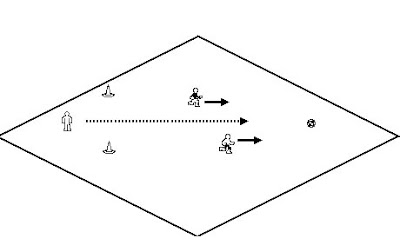
Set up a field that is 20X20 yards. Four players should be in each of the corners with the remaining two players in the middle of the grid. One of the two players are working while the other person rests with their hands on their knees. Two balls are used and the ball starts in opposite corners.

Instructions:
Player 1 passes the ball towards the player resting, the working player jumps over the player resting and receives the ball and knocks it to the player to his right. As soon as the working players plays the ball back, the player on the other side of the grid plays a ball towards the resting player and the working player jumps him again, receives the ball and passes to the player on his right. The play continues in this manner. Each player should work for 60 seconds. Rotate all players.

Variations:
  • Play 1 or 2 touch
  • Use inside and outside of foot
  • Move close and serve with their hands for volleys
Coaching Points:
  • Good first touch
  • Good work rate along with accurate passes

Tuesday, July 29, 2008

Under 8 Drill - "Protect the Ice Cream"


Objective - Accurate Passing or Finishing

Setup - Use flat cone and make a 3 yard by 3 yard grid. Put another flat cone in the middle of the grid and place a ball on top of the flat cone.

The Game - 3 attacking players against one defender. The 3 attacking players pass the ball to each other and score by knocking the soccer ball off the cone in the middle. No players are allowed in the grid. Does the ball need to always be passed through the grid?

Variations- Depending on the skill level, must complete a set number of passing before a shot. Make grid smaller to defender can defend easier which will force quicker and smarter passing.

Under 10 Drill - "The Bank Game"


Objective - Passing with pressure

Setup - two teams of 4 or 5 players. Each in a 40 X 40 grid (adjustable).

The Game- the coach sends a soccer ball into O's teams grid. The opposing team sends 1 players to play as a defender. The O's try to connect 4 passes in a row without the defender stealing or kicking ball out of bounds. Each time a team accomplishes this, they can make 100 bucks. Once they make a hundred bucks, they have 2 choices. Go for another hundred bucks or bank the money. To bank the money, they have to send the soccer ball back into the opposing teams grid and THEY send a defender to try to steal the ball. If the ball goes out of bound or is stolen, the coach sends a ball into the others teams grid.

Progressions -
  • Send in more than 1 defender
  • Make grids smaller
  • To make game easier - make grid larger and add a offensive player

Friday, July 11, 2008

Under 10 Drill - "Monkey In The Middle"


THE GAME:
Team A and B attempt to keep the ball away from team C by:
  1. Possessing the ball using their own players, or
  2. Passing the ball over or through the middle zone to the other team who are waiting in their own zone.
The defending teams are able to get out of the “middle” by:
  1. Replacing the team that loses the ball out of bounds, or
  2. Dispossessing a team and making a pass into the other grid to the waiting team (e.g. Stealing it from A and passing to B.
The defending team is only allowed to send three players into one of the grids at one time. The three remaining players must be back in the “middle” before the ball is sent into the other grid. They can not enter the grid until the ball does. If a ball is lost out of bounds, the coach immediately puts a ball into play in the other grid area, making the new defending team run to put immediate pressure on the ball. Make the grids bigger to allow the attacking team more success, smaller to challenge them more.

FIELD SIZE: coach’s discretion

COACHING POINTS:
  • Transition
  • Attacking principles: long passing, attacking shape, receiving long passes, support
  • Defending principles: pressure, cover, balance, compactness, immediate chase
  • Make sure: if teams are not eve, it is OK for a team to play one player down.
  • Keep the game flowing, if a ball goes out of bounds, immediately call out who is in the middle and put the next ball into play.
  • Defending team defends as a unit and keeps compact.
  • If an attacking team loses possession of the ball, they try to win it back before the defending team plays it out of their grid.

Thursday, July 10, 2008

The Give & Go Drill

This is a great drill to use for any type of passing lesson. It can be used from Under 8 up. I, normally, use this as a warm up drill for my older players, because it gets them moving around and focusing on proper passing and receiving. Also, it gives them looking around and also talking to the other players of when to pass by calling "Ball!"

Organization -
Players on the inside pass the ball the to the outside players, who either one-touch or two-touch the ball back to the players on the inside. Player on the inside should not receive pass from the same place they made their own pass from. MOVE! Players on the inside then dribble, find a new player on the outside to pass to. Players on the outside that are "open" should call "Ball!" to get inside players attention. Players should be using proper passing and receiving technique. Rotate after a couple of minutes.

Key Coaching Points -
  • Plant foot next to ball, pointed at target
  • Kicking foot has toe up and ankle locked
  • Proper weight on the ball
  • Communication
  • Accuracy of pass
  • Good first touch (for both players)
Variations -
  • Long pass out, short pass in
  • Short pass out, long pass in

Monday, July 7, 2008

Passing To The Net

Sometimes youth players get a bit too over eager in trying to score. They think if they hit the ball with a ton of force, it is going to automatically go in. The problem is that youth players may have all of the power in the world, but that means nothing with accuracy. Normally, they hit the ball a ton and it goes 5 yards over the crossbar.

Players need to realize that simply "Passing To The Net" works better than hitting it a ton. Yeah, it won't be one of those "Oh My!!" goals, but it still counts the same. Below is a video with Mia Hamm explaining the technique.


Tuesday, July 1, 2008

Push Pass Drills with Mia Hamm (Video)


Excellent Video with explanation of the Push Pass. Mia Hamm demonstrates the proper technique. Two excellent drills to use in practice to help get it home.

Thursday, June 26, 2008

Under 10 Drill - "Hit The Target Man"

Emphasis:
Laying balls off, passing, turning

Set-up:
4 flags are positioned approximately 4 yards apart in the center of a grid as shown. Players are split into 4 groups and are positioned 12-15 yards from each flag. 4 players are designated as target players and are positioned slightly in front of each flag. 2 cones are placed 4-5 yards (right and left) in front of the target player. 3-4 balls per group.

Objective:
The first player in line (A) passes a ball into the target player. The target player must lay the ball straight back approximately 4 yards to encourage the player to come forward to receive the return pass. The player then must spin around one of the cones before accelerating back to his group. The next player in line starts when the player in front is spinning around the cones. Play is continuous for a designated number of reps or time. Change the target player.

NOTE – The coach designates the direction he wants the players to spin around the cones.

Example –
#1 Inside of the right foot only, spin to your left.
#2 Outside of the right foot, spin to your right.

Progressions:
  1. Drive balls in to target man with laces. Target man can use his hands to catch ball before tossing ball back to oncoming player.
  2. This player must now use surfaces like thighs and chest to spin around cones.
Coaching Points:
  • Firm passes in to target.
  • Quality lay-offs from targets.
  • Try to spin around cones with the first touch – cone acts as a defender.

Wednesday, June 25, 2008

Under 8 Drill - "Ball Retrieve in Pairs"

Organization:
Each pair has a ball which in turn they give to the coach. The coach tosses the ball away and each pair must retrieve the ball as quickly as possible and bring it back to the coach. The players must bring the ball back a different way each time, e.g. balanced between two backs, balanced between two heads, throwing the ball to each other, passing the ball to each other. The coach can also limit the number of touches a pair may have when returning the ball.

Variation:
The coach may move and change position which encourages players to look up.

Thursday, June 19, 2008

Under 10 Drill - "Four Grid Passing"

Start with a 30 x 30 grid and divide into 4 equal parts.

The two primary rules are:
  • At no point may a team possess the ball and have more than two players in any of the smaller grids
  • When a player passes the ball, they must sprint into a different grid
If there are more than 2 players in a grid when a team has the ball, they immediately lose possession of the ball. If a player passes the ball and doesn't immediately sprint to a different grid, they immediately lose possession of the ball.

When a team wins the ball (transitions from defense to offense, there is a slight delay allowed so that the players have time to sprint to spread the field. Three players (or more) are allowed in the same grid on so enough time needs to be allowed so the players can get to the appropriate spacing.In the beginning, it might be best to have one or two neutral players in this game so that whichever team has the ball has 7 v 5. Even with these neutral players, the same rules would apply (no more than 2 attacking players in a grid at a time and a sprint to a different grid after a pass).

This is a great game to work on possession, movement off the ball and communication.

Wednesday, June 18, 2008

The Outside of the Foot Pass/Shoot - Ricardo Quaresma

The "Trivela" kick is a sneaky kick because it comes off of the outside part of the foot. Ricardo Quaresma, currently a player on FC Porto in Portugal, is a master of it and thus a very dangerous player. Quaresma ability to use the outside part of the foot can deceive a defender, because he can make a pass to the side in the blink of an eye. Using the outside part of the foot during a shoot can put a wicked spin on the ball confusing a goalkeeper, who may think at first the ball is going one way, but then bends back and goes into the goal.


Thursday, June 12, 2008

Under 8 Drill - "Junkyard" With Video

Getting younger players to properly shoot the soccer ball and get the wanted distance is sometimes a hard thing to coach. Some coaches think that all shooting/finishing must involve the player taking aim at the goal. Shooting and finishing does involve the goal, but want about the long pass down the field or a diagonal long pass to change the angle of attack? Also, is it any fun to shoot at the goal and then having to dig the ball out of the back of the net?

Junkyard is a great activity to get the players really hitting the ball. It makes them to focus on distance and accuracy. Also, the players are automatically in position to keep the balls moving and eliminating down time.

Under 8 Drill - "Crush The Snow Cone"


This is a passing drill with emphasis on hitting a target under pressure.

Organization:
  1. Teams are split into two teams. For this example, a red and a yellow team.
  2. The yellow team has to keep possession of the two soccer balls that are in the field of play and hit the balls off the cones.
  3. The red team has to defend and not allow them to strike the ball off of the cones.

Coaching Points:

  1. Keep your head up to see where the snow cones are not defended.
  2. Use either the laces or the side of the foot to knock ball off of the cone.
  3. If the cone is defended dribble off to find the open cone.

Under 12 Drill - "Take Over"


This drill helps in teaching the "take over" pass, which exactly what it is - another player taking over for another.

Organization:
  1. Player 1 dribbles through the middle and towards another player, in this case Player 2.
  2. Player 2 moves towards the ball and shouts "TAKE!"
  3. Player 1 on hearing this leaves the ball and allows the ball off to someone else.
  4. When doing the take it must be performed right foot to right foot or left foot to left foot.

Coaching Points:

  1. Keep the ball close
  2. Head Up
  3. Good Communication
  4. Confuses other team allowing change of direction

Wednesday, June 11, 2008

Backyard Activities - "Trashcan Kicking and Marbles"

Backyard Activities are drills that a player can do at home with a sibling, a friend, Mom, or Dad.

Activity - "TRASHCAN KICKING AND MARBLES"

Trash Can Kicking: Lay a clean, plastic trash can on its side in the back yard. Place a ball 2-3 yards away from the opening of the trash can. Practice kicking stationary balls into the trash can. This can save you from chasing your soccer ball. You can also kick the ball into the side netting of a big soccer goal. The ball will bounce back at you.
Work on the technique of kicking (shooting and passing):
  • Approach the ball from a slight angle.
  • Practice approaches at different speeds (the faster the more power)
  • Vary the size of your last step (power step) into the kick (the larger the more power)
  • Use the outside of your foot, inside of your foot and the laces (instep)
  • Lock your foot when kicking the ball
  • Always keep your eyes on the ball when striking it
  • Strike the ball on different parts of the ball:
    - lower half will send the ball up
    - midline (equator) will send the ball level to the ground
    - upper half will drive the ball down

Marbles: Put a ball (or cone or soda can) in the middle of the yard. Kick your ball and try to hit the stationary ball. Vary the distance. Have fun competing with your friend or your mom or dad.

Backyard Activities - "Kicking (Wall) Tennis and Squash"

Backyard Activities are drills that a player can do at home with a sibling, a friend, Mom, or Dad.

Activity - "KICKING (WALL) TENNIS AND SQUASH"

If you have access to a wall that you can kick your soccer ball against and your parents permission, consider the following soccer activities:


Tennis: Volley your ball against the wall with one or two bounces in between each volley. Eventually, keep the ball going with only one bounce in between volleys. Vary your distance from the wall as you play. See how many times you can keep the ball going as you move closer to and farther from the wall. Use different surfaces of your foot and develop a rhythm.


Set up a rectangular court out from the wall and play soccer tennis against the wall with a friend. Set up your own rules with regards to services and bounces, etc.


Squash: This game is played with more than one player. You can set up a rectangular court or play in an open area.


After a kicking order has been determined, the player #1 kicks the ball off the wall. The player #2 must get to the ball before it stops and immediately kick (1-touch) the ball against the wall. If there are more than 2 players, the game proceeds accordingly until all the players have kicked the ball against the wall, at which time the first player is up again. You get a point if the player that follows you allows the ball to stop before she kicks it or if she misses the wall on her kick. Play begins with the next player in the order striking the ball against the wall.


This is a great game for scheming (strategy)…putting the right pace on the ball so that it barely moves after hitting the wall or rebounds off the wall with great speed. Passing angles become a strategic threat in this game as well.

Backyard Activities - "Kicking (Wall) Straight and Angled"

Backyard Activities are drills that a player can do at home with a sibling, a friend, Mom, or Dad.

Activity - "KICKING (WALL) STRAIGHT AND ANGLED"

If you have access to a wall that you can kick your soccer ball against and your parents permission, consider the following soccer activities:

Straight On: Kick your ball directly against the wall at different speeds (pace or weight) and from different distances. Use different surfaces of the foot. Try to keep the ball on the ground. Receive the rebound with different surfaces of the foot, always trying to keep the first touch within playing distance (about 1 or 2 steps from you). Receive the rebound with a controlling touch or two and then kick it against the wall again. Keep the ball moving and keep your feet moving at all times.

  • Kicking surfaces: inside of the foot, outside of the foot, instep (laces), heel
  • Receiving surfaces: inside of foot, outside of foot, sole of foot

Angles: Position yourself about 10 yards away and at one end of the wall. Kick your ball on the ground toward the middle of the wall (about 45 degrees). Immediately after kicking the ball, run to receive it as it rebounds from the wall to the opposite end. Perform a change of direction move and repeat the activity in the opposite direction. Experiment with the pace and the angles of your kicks, as well as your receiving surfaces and number of controlling touches. Always try to keep the all moving.


Change of Direction Moves: Pull back with sole of one foot and push behind other foot; chop with inside or outside of foot.

Backyard Activities - "Combat"

Backyard Activities are drills that a player can do at home with a sibling, a friend, Mom, or Dad.

Activity - "COMBAT!"

Set up a goal with cones about 4 steps wide. You stand behind one of the cones with the ball and your friend stands behind the other cone without a ball. Both of you face the same direction. You must throw or kick the ball about 10-15 yards out into the area that you and your friend are facing. The instant the ball is struck, both of you must attempt to get it (gain possession of the ball) and dribble it back through the goal. Play for 20-30 seconds. Alternate the server each time.


If your Mom or Dad is available, they can serve the ball from a position away from the goal and keep time. This is a great 1 versus 1 activity.

Options: Mom serves (kicks) the ball out into the yard and you and your friend compete to get the ball back to her, instead of going through the goal.

This is a great activity to work on playing with pressure from behind. Thus the players must shield the ball often, escape the pressure of their opponent and create a space large enough to pass the ball back to the coach.

Wednesday, June 4, 2008

The Small Sided Game of 3v3

There is a reason that we start out playing 3v3 soccer in the Under 6 ages and should actually encourage this type of play in practices as players get older. It gives players plenty of opportunities to touch the ball and develop their skills and it highlights the basics of soccer - good dribbling and spreading out.

In this video, the coach sets up the game and stays the "Boss of the Balls". If a ball goes out, he throws another one in to keep the action going. To encourage them further, he gives points not only for goals for certain skill moves.


Tuesday, June 3, 2008

Under 8 Drill - "Gates" with Video

One of the downfalls of the typical passing drill is that the players are always standing still. One player stands at one spot and the other player at another spot and they pass back and forth. The drill is static, which is not what happens in an actual game of soccer. In an actual game, players are in movement. If you coach passing with players standing still, they will either A) stand still in the game passing and/or B) will not move to receive the next pass. Players need to be in movement at all times.

"Gates" is the perfect game to teach passing and movement. Set up more gates than you have pairs. Don't have a ratio less than 3:2 - 3 gates for every 2 pairs. At the start, Player One starts with the ball, Player Two finds an open gate (if another pair is at the gate already, find another gate). Player One dribbles close to the gate and passes the ball through the gate to Player Two, Player One goes to find an open gate and so on and so on. Focus on proper passing technique, players getting their heads up looking for the next gate, and quick dribbling movements.

Pairs should see how many gates they can do in one minute. A good rule of thumb is the age of the player to gates. So a pair of 8 year-olds should be able to do 8 gates in one minute. I've seen some older players get up to 20 gates in one minute, but this was with highly accurate passing. Have players do this drill and see if they can always improve by one gate each one minute session.